Who is a thin file customer
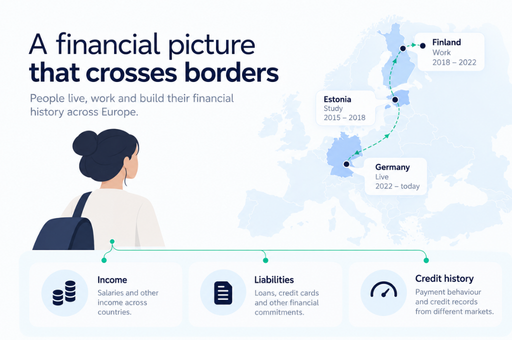
A customer becomes a thin file the moment their financial history is split across countries.

A domestic customer with 100% of their financial data in one country is a full file. A multi-country customer is a thin file in every individual country, because part of their financial activity sits elsewhere.
The only variable is how that data is distributed. It can be 50% in one country and 50% in another, 80% and 20%, or even 20% and 80%. In every case, part of the customer’s financial obligations sits outside the system the bank is using.
From the perspective of any single country, the dataset is incomplete.
Credit data in Europe is organised nationally. Multi-country customers are assessed through fragmented records by default.
Thin file starts with the first cross-border activity
One financial action outside the home country is enough to create this split. Some examples:
- A Nordic customer takes a mortgage in Spain. The obligation is recorded in Spain and does not appear in the home country file.
- A cross-border commuter earns in one country and borrows in another. Each system captures only part of their financial activity.
- A returning expat brings years of repayment history from abroad. The domestic system shows limited recent data.
The data exists across systems. Each system holds only a portion.
Credit decisions require full visibility
Credit assessment depends on a complete view of existing obligations. Responsible lending and CCD2 require comprehensive creditworthiness checks, including relevant data from other countries. The standard is full visibility.
Partial data leads to incomplete assessment. The size of the gap varies. The outcome does not. For multi-country customers, incomplete visibility is built into the current infrastructure.
Credit models rely on observed obligations and repayment behaviour. Missing data is treated as uncertainty. Applications are declined, pricing is adjusted, and additional checks are introduced.
The assessment reflects partial information.
Accepting a credit decision based on incomplete data also leads to potential breaches of responsible lending principles, as not all customer obligations are taken into account.
Banks we work with report that customers with foreign or multi-country credit histories show risk levels up to seven times lower when assessed on full cross-border data compared to domestic-only assessments. The difference comes from data completeness.
What this means for credit teams
Thin file appears as a customer category in reporting. It originates from data fragmentation.
Around 45 million people in Europe live or operate financially across borders. Many banks report 10-15% of applicants with cross-border profiles. A material share of decisions is based on incomplete datasets.
Access to cross-border credit data completes the customer profile. Payment behaviour, existing obligations, and financial activity become visible across countries in a consistent format. Credit teams apply existing policies and models to a complete dataset.
A growing share of applicants have financial histories distributed across countries. Assessments based on one country leave part of the obligation set outside the decision. Thin file follows from how data is stored. The constraint is access to complete information.