What will change for cross-border credit data in 2026 and why banks need to prepare now
For years banks referenced cross-border credit data in strategies but mainly relied on domestic data; by 2026 gap ends.
.png)
From November 2026, EU banking supervisors will begin auditing whether banks’ credit assessments rely on sufficient and relevant information in a non-discriminatory way, regardless of whether the customer is domestic or foreign. "No local credit history" will no longer be a sufficient explanation for rejection or manual processing.
The revised Second Consumer Credit Directive (CCD2) will already be transposed across many Member States. But enforcement will begin to shape how credit decisions are examined, challenged, and justified in practice.
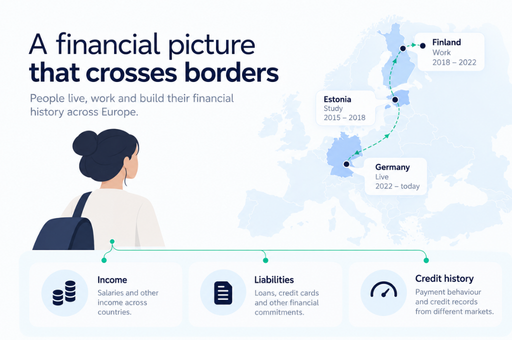
For banks operating in Europe where people live, work and borrow across borders, this shift has a specific implication.
Cross-border credit data will no longer sit at the margins of lending operations, treated as a technical limitation or an exception to standard processes. It will increasingly become a factor that supervisors, auditors, and consumers expect lenders to have addressed in a structured and defensible way.
This change stems from enforcement. Supervisors will scrutinise how banks apply existing obligations to a Europe where people live, work, and borrow across borders.
Cross-border credit data becomes infrastructure
By 2026, cross-border credit data will no longer be a peripheral concern or a feature in pilot projects. It becomes an integral part of the credit stack, essential for evaluating customers whose financial lives span multiple jurisdictions. CCD2 enforcement reinforces the expectation that risk is assessed properly, consistently, and transparently across a mobile European population without requiring banks to take on additional risk. By integrating cross-border credit data into core processes, banks make it part of what defines responsible lending in practice.
This shift highlights the potential of cross-border data to serve as genuine infrastructure, with practical operational considerations. For maximum value, the data should ideally be consistently available, standardised across markets, embedded in decision logic and aligned with multiple regulatory frameworks. It should support real-time decision-making, integrate with risk and fraud systems and flow smoothly into reporting and analytics. Simply having access to the data is not enough. Its full potential is realized when it can be operationally applied within daily workflows.
Operational cross-border data enables banks to build richer, multi-dimensional customer profiles and supports consistent, repeatable and auditable processes across markets. Investments in this infrastructure can enhance product design, customer service and risk management. Banks that leverage these capabilities early are better positioned to capture growth in Europe’s €719 billion cross-border lending market and to serve an increasingly mobile EU customer base more effectively.
Risk models will start to ingest foreign data
Foreign credit data becomes a standard input in risk assessment. The debate over whether to use it fades.
Operational questions replace strategic ones. Banks focus on how foreign data is normalised, how it maps into local risk frameworks and how it compares with domestic records.
Risk models that cannot absorb cross-border inputs produce incomplete risk views and misprice customers whose financial lives span multiple markets.
Credit decisioning shifts from nationality-based to profile-based
Nationality and country of residence have served as rough risk proxies. They persist where better signals are unavailable.
In 2026, credit decisions rely more heavily on observed credit behaviour, repayment patterns and financial history, regardless of origin. A credit profile follows the individual rather than remaining tied to a jurisdiction.
Banks that adapt assess risk with greater precision. Banks that do not remain dependent on approximations.
The changing status of "no local credit history"
For many lenders, "no local credit history" has functioned as a neutral absence rather than a signal. It has justified conservative decisions, manual reviews, or outright rejections without further interrogation.
By 2026, that position becomes less stable.
Supervisory expectations are moving toward proportionality and reasoned decision-making. When a consumer has lived and borrowed in another Member State, the absence of domestic data is no longer a complete explanation. It prompts a follow-up question: was relevant information available elsewhere, and was it considered?
Banks remain free to decline credit based on risk appetite. The logic behind rejections and downgrades must be clearer, more specific, and better documented. "No data" begins to look less like a fact and more like a decision outcome.
Non-discrimination moves from principle to practice
EU consumer credit law has long prohibited discrimination based on nationality or residence (Article 6 of the revised Consumer Credit Directive). In practice, however, data fragmentation has created indirect barriers that are difficult to resolve within national lending infrastructures.
Foreign applicants are more likely to face higher rejection rates, stricter conditions, or manual handling because their financial history is not visible to the lender. While these outcomes are rarely framed as discriminatory, they produce unequal access to credit in practice.
As CCD2 enforcement progresses, supervisors are likely to focus more on outcomes than intentions. If two EU residents with comparable financial profiles are treated differently because one has a domestic credit file and the other does not, lenders may be asked to explain how this aligns with proportionality and equal treatment obligations.
Closing this gap becomes a governance and risk issue alongside its fairness implications.
Explainability becomes a data issue
The ability to explain credit decisions clearly and specifically is central to consumer protection under CCD2. Generic explanations are increasingly insufficient, particularly when decisions are challenged.
Cross-border cases expose this weakness quickly. Consider a Polish customer with established credit history in Warsaw applying for a mortgage in Berlin. Telling them their application was rejected due to "insufficient information" becomes problematic when that consumer has an established credit history elsewhere in the EU. Even if that data was inaccessible, the explanation may still appear incomplete from the consumer's perspective and difficult to defend to supervisors.
This creates a dual risk. Poor explainability increases the likelihood of complaints and remediation. It also makes supervisory reviews more difficult, as decision rationales lack concrete, auditable inputs.
In this context, access to relevant data and the ability to articulate how it was used are inseparable.
Manual review will not scale as a long-term solution
Many banks have managed cross-border cases through manual review processes. This approach provides flexibility, but it carries hidden costs and risks.
Manual reviews are slow, difficult to standardise, and create inconsistent outcomes. Documentation is often incomplete, and audit trails are harder to reconstruct. As volumes grow (with mobile EU citizens representing a significant and expanding customer segment) these weaknesses become more visible.
By 2026, reliance on manual handling for a structurally significant customer segment will be harder to justify. Supervisors may question why foreign applicants require exception handling rather than integrated assessment processes, particularly when mobility within the EU continues to increase.
What once looked pragmatic begins to look like a structural gap.
Five questions supervisors may ask about foreign-customer decisions
Enforcement does not introduce a checklist, but patterns are emerging in supervisory focus. Banks should expect increasing attention on whether they can demonstrate:
1. That relevant credit databases were considered where appropriate
Can the bank show it attempted to access cross-border credit information when assessing foreign applicants?
2. That the absence of data was unavoidable rather than assumed
Did the bank treat "no local history" as a starting assumption, or did it take reasonable steps to verify whether foreign data was accessible?
3. That decision logic for foreign applicants is documented and consistent
Are foreign-customer assessments governed by clear, auditable criteria, or handled case-by-case without standardisation?
4. That adverse decisions can be explained clearly to consumers
Can rejections be justified with specific, comprehensible reasons rather than generic statements?
5. That governance frameworks address cross-border cases explicitly
Do credit policies recognise mobile EU citizens as a distinct segment with defined assessment procedures?
These expectations reflect a shift toward transparency and accountability in lending decisions.
What changes in practice over the next 12 months
Preparing for 2026 requires a reassessment of assumptions rather than a radical overhaul of credit models.
Banks will need to treat cross-border credit data access as part of their core infrastructure rather than an optional enhancement. Decision frameworks for foreign applicants will need to be formalised and aligned with existing risk and compliance standards. Reliance on manual exceptions will need to decline in favour of scalable, auditable processes.
Most importantly, credit policy language will need to reflect operational reality. If a bank cannot assess a mobile EU consumer fairly, it must be clear why, and what is being done to close that gap.