Portuguese banks can’t see 1 in 4 customers’ credit history. The new 45% cap makes that costly
Lost good customers, missed hidden debt: how foreign credit history shapes risk and compliance for Portuguese lenders.
The largest group of newcomers is Brazilian. With Banco de Portugal's debt-service cap down to 45%, what banks can't see now matters more.
Two customers apply to the same Lisbon branch in the same week.
The first moved from São Paulo eight months ago. She has a permanent job, a Portuguese salary account and eleven years of on-time payments in Brazil. She asks for a car loan. Banco de Portugal's Central Credit Register shows almost nothing, so the application goes to manual review, and she takes her business to another bank.
The second arrived from Belo Horizonte a year ago. His register file is clean, because it does not show the car loan and personal loan he is still paying off in Brazil. His mortgage is approved on a debt-service ratio that leaves those payments out.
One good customer lost, one risk missed. Both for the same reason: the credit history that matters sits outside Portugal.
Not an edge case
Portugal is home to 1.6 million foreign nationals, 14% of residents and more than double the 2021 figure, according to INE. At the same time, around one in five people born in Portugal live abroad, and many keep accounts, buy property or eventually return home.
Mifundo estimates that around 3.5 million people in Portugal's banking market have a credit history held at least partly by foreign bureaus and banks. That is roughly one in four of the 13.3 million residents and Portuguese citizens abroad who make up the market. By that measure, Portugal has one of the largest cross-border customer segments in Europe relative to its size.
On the same estimates, the segment takes out more than €4 billion of new mortgages and consumer credit a year.
The Brazilian connection
Brazilians are the largest group. INE counted 574,195 Brazilian nationals in Portugal at the end of 2025: more than a third of all foreign residents, and the largest Brazilian community in Europe. Brazil's foreign ministry counts 628,000, partly because it includes Brazilians who already hold Portuguese citizenship.
That difference matters for credit teams. A Brazilian who becomes a Portuguese citizen drops out of the foreign-resident statistics, and often out of a bank's own "foreign customer" flag. Their credit history stays in Brazil.
They are active home buyers too. In 2025, people born outside Portugal bought more than one in four homes purchased by households, and buyers born in Brazil led with 9,808 purchases.
Their credit history is also unusually well documented. Since 2019, Brazil's Cadastro Positivo has automatically recorded repayment behaviour on loans, instalment purchases and even utility bills. The data exists; until recently, Portuguese banks could not reach it.
A 45% cap on debts the bank can't see
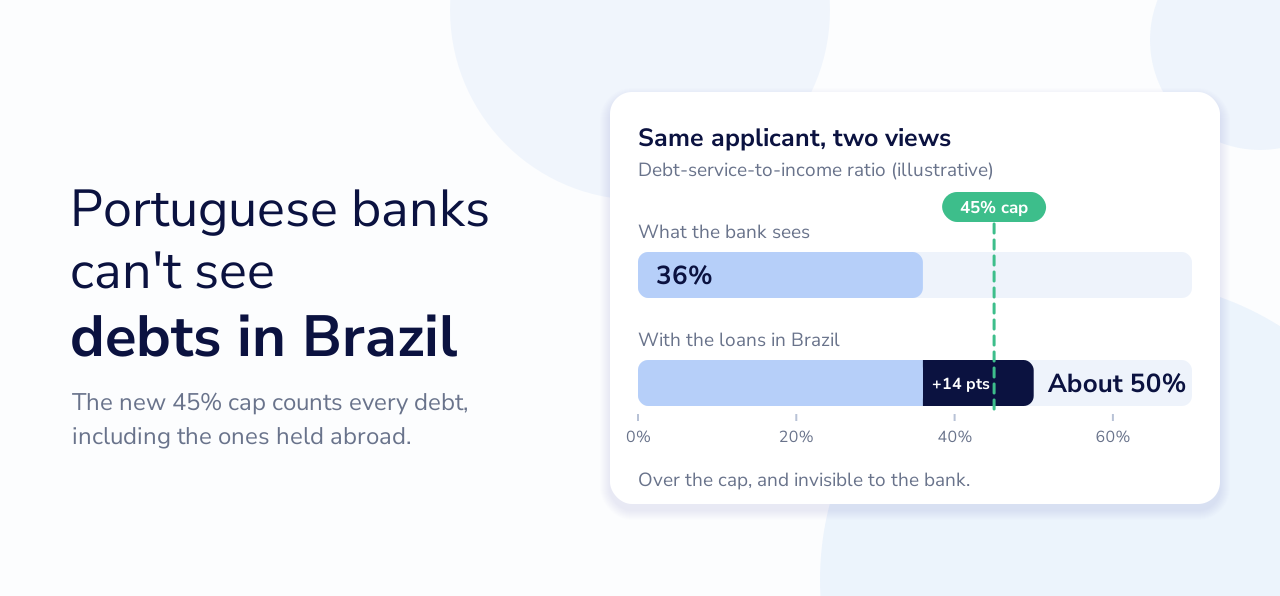
Since 1 August, Banco de Portugal's Macroprudential Recommendation 1/2026 has capped the debt-service-to-income ratio (DSTI) for new mortgages and consumer credit at 45%, down from 50%. Banks can go above the cap for only 10% of the amount they lend each semester. And DSTI is meant to include the instalments on all of a borrower's other loans.
The Central Credit Register shows only credit granted in Portugal. Take the second applicant: he earns €2,800 a month after tax, and on the bank's figures his new mortgage puts his DSTI at about 36%. Add the €400 a month he still pays on loans in Brazil and it is about 50%, above the cap and invisible to the bank.
The opposite error costs just as much. Applicants with long, clean histories abroad look like beginners at home, so banks decline them, send them to weeks of manual review, or approve them on self-declared information and PDFs that are increasingly easy to fake.
Neither error is about the customer; both are about the data. Complete data clears the first applicant and catches the second. Across the banks Mifundo works with, foreign customers assessed on their full cross-border history carry risk profiles around seven times lower than those assessed on domestic data alone.
Supervisors have expected complete information since 2021, when the EBA's loan origination guidelines asked banks to verify all of a borrower's financial commitments.
Verified Brazilian credit data, inside the Portuguese credit process
Since May 2026, Mifundo's partnership with Equifax BoaVista has given European lenders access to verified Brazilian credit data, alongside bureau data from more than 20 European countries.
With the applicant's consent, Mifundo retrieves repayment behaviour, existing obligations and credit usage directly from the source, including for people with thin files in Brazil. The bank receives one standardised report that its existing credit process can use, so obligations in Brazil can be counted alongside those in Portugal. The applicant spends minutes, not weeks.
The bank still decides according to its own policies and risk appetite, and it can start without an IT integration on a defined group of applicants. Libra Internet Bank in Romania already assesses its diaspora customers this way, using verified data from the countries where they live and work.
CCD2 turns the data gap into a compliance issue
From 20 November 2026, the revised Consumer Credit Directive (CCD2) applies to consumer credit. Two provisions matter for customers with histories abroad:
- Article 18 requires a thorough creditworthiness assessment based on accurate information about the borrower’s financial commitments. Brazilian loans the Central Credit Register can’t see are a gap.
- Article 6 bars credit conditions that discriminate on nationality or place of residence for consumers legally resident in the EU. Declining someone only because their history sits abroad becomes harder to defend once that history can be verified.
Missing data can create both risks: unseen debts on one side, ignored track records on the other. Verified cross-border data, retrieved with the applicant’s consent, addresses both and leaves an audit trail that self-declared figures and PDFs don’t.
Banks should confirm with their compliance teams how CCD2 applies to their products.
Three questions for your credit team
- How many applicants last year had less than two years of history in the Central Credit Register?
- How many of them were born in Brazil, or lived and worked abroad before applying?
- What share did you decline, send to manual review or approve on self-declared information?
If the answers are large, so is the gap. Mifundo's 5-step audit shows how to size it.
The customers are already in Portuguese branches. Their credit histories are one consent away.
See how Mifundo works for banks in Portugal at mifundo.com.